
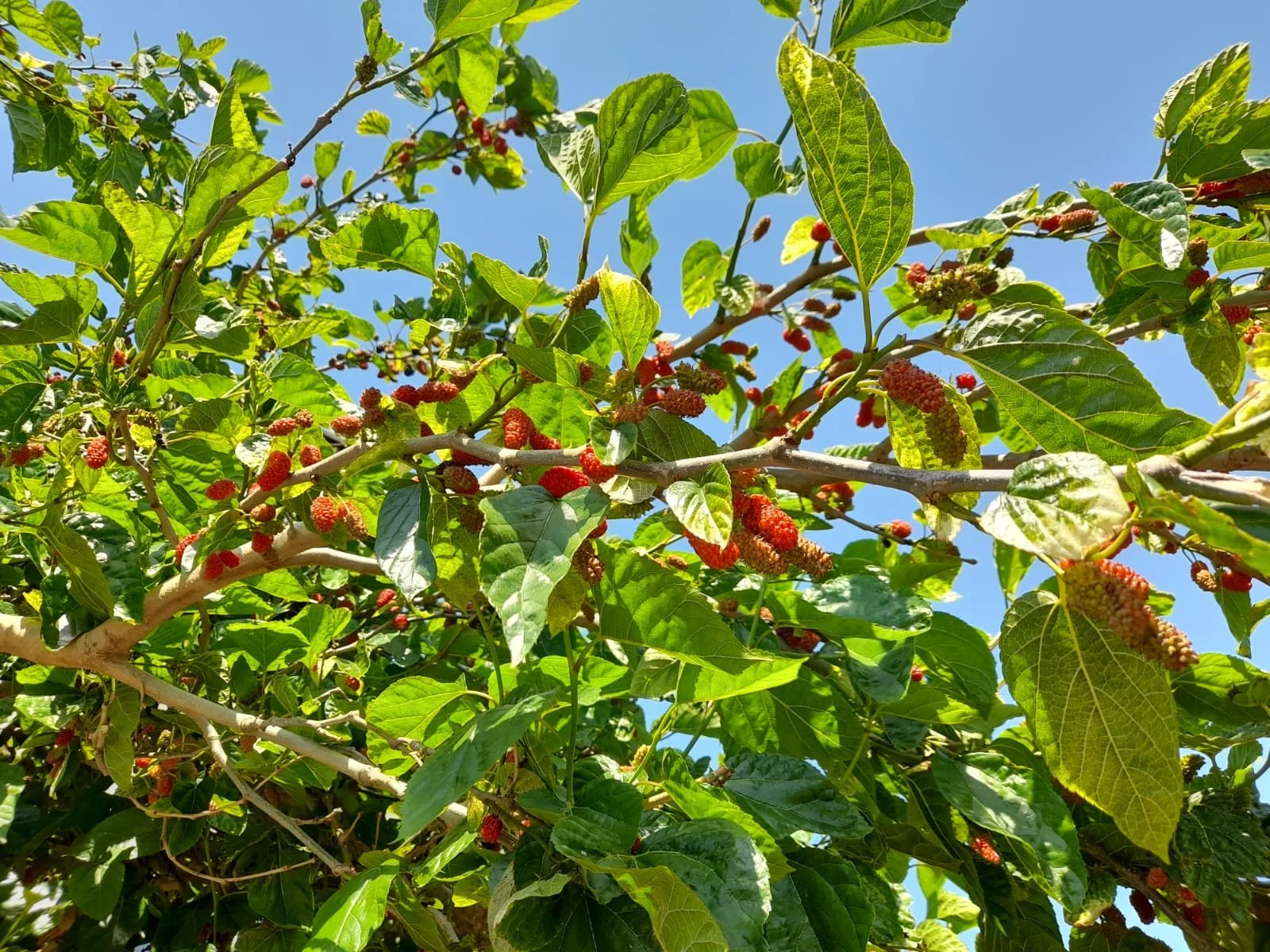
Summertime and 5 unusual plant picks nobody is talking about.
Walk through any well-kept garden this June, and you'll see the same confident cast: the roses doing their reliable thing, the lavender humming with bees, the echinaceas holding the fort from July onwards. These are good plants, honest plants — and there is no argument here against any of them. But gardens built entirely on the familiar have a ceiling. They are beautiful in a way that stops surprising you, and a garden that stops surprising you has, in a quiet sense, stopped being a garden at all.
The conversation in serious planting circles right now is about texture, restraint, sensory intelligence, sound and movement. The way a stem catches low evening light. With that in mind, here are five summer plants that are doing exactly that work :
01.Knautia macedonica Macedonian scabious
Deep crimson pincushion flowers, held on wiry branching stems, from June right through to September. It self-seeds with a casual generosity that makes a border feel lived-in rather than planted-to-a-plan, which is, right now, exactly the aesthetic the best garden designers are chasing. Pollinators treat it as essential infrastructure. Slugs, remarkably, leave it entirely alone. Why it works: it gives you the richness of a dark-flowered rose at a fraction of the maintenance cost, and it moves beautifully in the wind.
02. Melica altissima 'Atropurpurea' Purple Siberian melic grass
At Chelsea this year, it was Stipa tenuissima that drew the crowds for its feathery, light-catching movement. But step one pace sideways from the obvious, and you find Melica altissima — arching, architectural, its drooping flower spikes flushed burgundy in a way that photographs almost impossibly well in evening light. It tolerates partial shade with ease, which makes it genuinely useful in the kinds of north-facing town gardens where most grasses give up. Why it works: it offers everything Stipa does, but with depth of colour and a shade tolerance that opens up entirely different planting possibilities.
03. Agastache 'Blue Fortune' Giant hyssop
A heritage variety that has been quietly cultivated since the 1950s, and one that still outperforms most of its newer, more heavily marketed rivals. Upright spikes of soft blue-violet from July through to the first frosts, with anise-scented foliage that rewards brushing past — the kind of incidental sensory moment. Bees treat it as a destination. Why it works: the long season, the scent, the pollinator value, and a blue that reads as genuinely cool in the heat of high summer.
04. Dipsacus fullonum Common teasel
Most gardeners pull it out on sight (I was one of them). This is a mistake that deserves more pushback than it gets. The architectural ambition of a mature teasel — tall, spiny, deeply structural — is almost impossible to replicate with a cultivated plant. In late summer, the narrow band of flowers that travels slowly up each cone is one of the quiet spectacles of the garden year. Leave the seedheads standing, and goldfinches will find them within days. Why it works: it contributes verticality, wildlife value, and a quietly dramatic presence that no nursery-bought alternative quite matches.
05.Succisa pratensis Devil's bit scabious
A native meadow plant almost absent from the modern designed garden, displaced by showier cousins that deliver more spectacle and considerably less ecological honesty. Soft lilac-blue flowers on slender stems from August onwards. It asks almost nothing of you. And its particular quality of late-summer blue — muted, dusty, completely unforced — is the kind of colour that makes everything planted near it look more considered than it actually is. Why it works: late-season colour, zero fuss, and the kind of native credibility that makes a planting scheme feel genuinely rooted in its landscape.
What links these five plants is not rarity. It is a quality of intention — the sense that they were chosen because of what they actually do in a garden, rather than what they look like on a label. The distinction matters, and you can feel it the moment you stand in a border built on that principle versus one assembled from habit.
The design conversation happening at the highest level right now — the one that produced a five-star Chelsea garden this year built on restraint and the Japanese concept of Ma, the idea that what is left out is as important as what is left in — is the same conversation worth having in any garden, at any scale. Not: how do I fill this space? But: what does this space actually need? Start there, and the plant choices tend to get more interesting very quickly.
This summer, look slightly past the front page of the nursery catalogue. The plants worth knowing are usually one shelf further back.
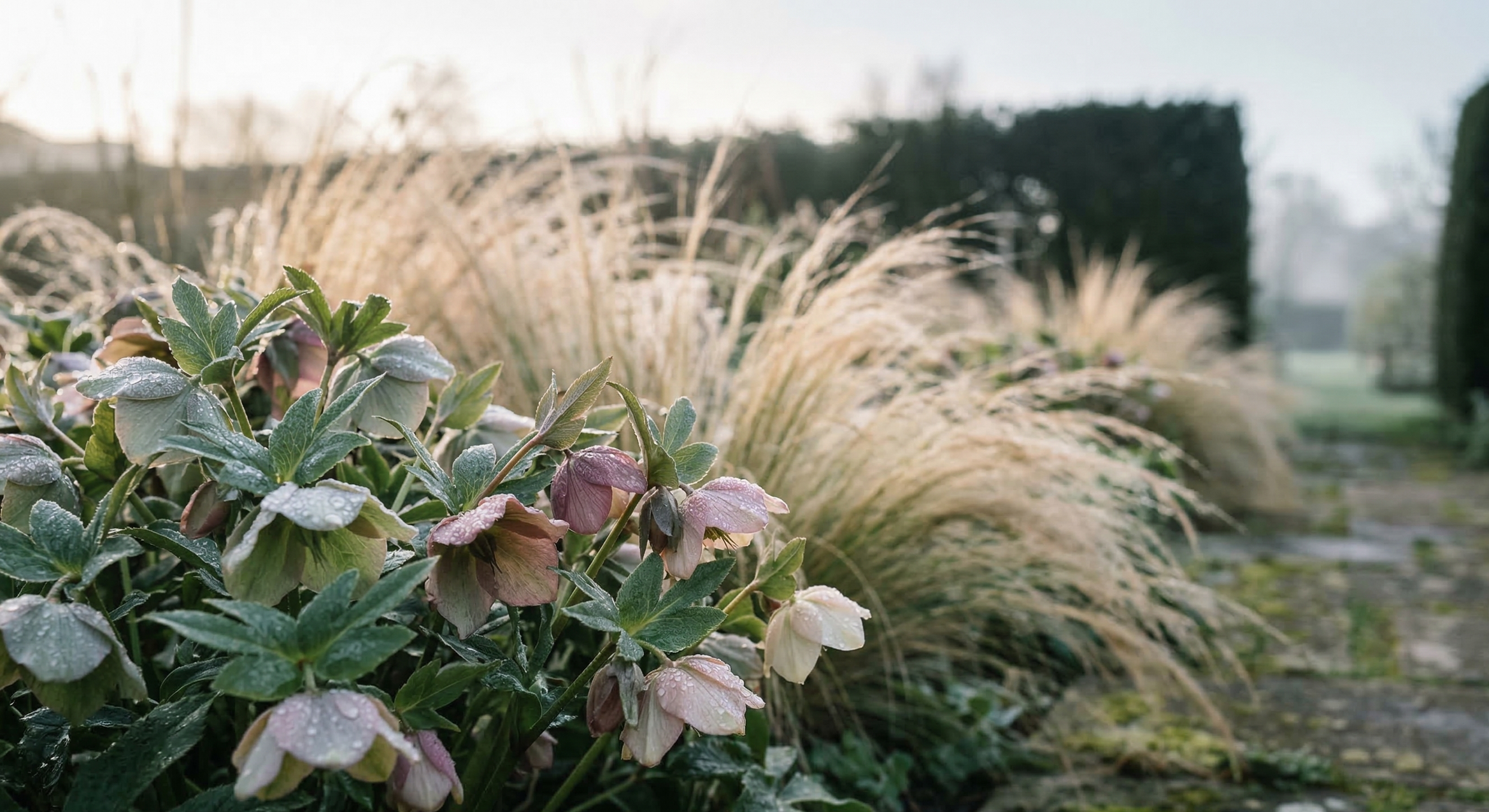
Gardens in motion.
“On learning to read a garden that is always becoming something else — and why that might be the whole point.”
There is a particular kind of morning in March, usually, or the tail end of February, when you step into the garden, and something has shifted overnight. Not dramatically. No headline event. But the quality of the light has changed, or a clump of hellebores has quietly turned its face upward, or the blackbirds have started up an argument that feels distinctly seasonal. You weren't expecting it. You weren't watching. And yet here it is: the garden has moved on without you.
This is what I want to write about. Not gardens as static objects — not beds to be managed and borders to be kept — but gardens as living systems perpetually in motion, always edging toward something, always letting something go. If you've spent any time outside in recent years, really outside and paying attention, you'll know exactly what I mean. Gardens are not finished things. They are, if anything, the opposite: they are arguments against the idea of finished.
The myth of the designed garden
We are sold a particular image of the garden. Symmetry. Restraint. The kind of outdoor space that looks, in photography at least, as though a gardener of almost supernatural dedication has arrived each morning to ensure nothing is ever out of place. These images are beautiful, and I don't say this dismissively — there is genuine artistry in formal garden design. But they can give us a slightly false picture of what a garden actually is, day to day, season to season.
Kendra Wilson, whose writing on sensory gardening has quietly shifted the way many of us think about our outside spaces, makes a point that has stayed with me: that a garden is most alive not when it is precise, but when it offers something to engage with. Texture. Movement. The small surprise. She describes a garden that rewards attention — not the attention of inspection, but the gentler, more open attention of simply being present in a space. That shift in language matters. It moves us from control toward something closer to conversation.
A garden is always becoming. The question worth sitting with is: becoming what — and are we paying close enough attention to notice?
What motion actually means
When horticulturists and garden designers talk about movement, they often mean it literally: the way Stipa tenuissima catches even the faintest breath of wind, or how the long wands of Verbena bonariensis sway in a way that makes a border feel animated rather than planted. This matters enormously, and we'll return to specific plants in future posts. But there is a deeper motion happening beneath the visible one.
A garden moves through time. Not just through seasons — though the rhythm of the gardening year, from the tentative bulb tips of January through to the long amber exhale of October, is one of the most satisfying natural narratives there is — but through years, through decades. The oak you planted for your children will outlive your grandchildren. The self-seeded foxgloves appearing in unexpected corners are the garden's own editorial decisions, not yours. Plants colonise, retreat, evolve partnerships with soil fungi you'll never see. The garden has its own agenda, and good garden design works with that agenda rather than against it.
For design-conscious homeowners, this can feel like a tension. You invest significantly in a planting scheme, a layout, a vision — and then nature starts renegotiating. But the most interesting gardens I've spent time in, both professionally and personally, are the ones where the designer understood this from the beginning. Where the initial plan was generous enough to allow for change, layered enough to remain coherent through the mess of growth, and honest enough to acknowledge that a garden in year ten will look nothing like a garden in year one. That evolution is not a failure of the design. It is the design working.
The sensory case for impermanence
There is also something to be said for what impermanence does to our experience of a garden. The Japanese concept of mono no aware (物の哀れ) — often translated as the bittersweet awareness of things passing — is perhaps most famously illustrated by the cherry blossom: treasured precisely because it lasts only a week or two. In the English garden, we have our own version of this. The sweet pea season. The fleeting, unrepeatable scent of a Rosa 'Tuscany Superb' on a warm June evening. The single October afternoon when the Liquidambar is exactly the shade of red you'd been waiting for all autumn.
These moments cannot be manufactured. They can only be set up — by the choices you make, the plants you include, the structure you give the garden — and then allowed to arrive in their own time. This is, I think, what separates the gardens that feel truly alive from those that feel merely well-maintained. The former have been designed with an understanding that sensation is temporal, and that the most moving things in a garden are the ones that require you to be there at the right moment, paying attention.
Wilson's approach to sensory gardening asks us to consider every plant in terms of what it gives to the senses — not just visually, but through scent, through sound, through touch. A clump of ornamental grasses does not just look good; it speaks in the wind. A path of thyme releases its oils underfoot. The garden, understood this way, becomes less a thing to look at and more a thing to be inside. And being inside something that is constantly changing is a very different experience from visiting something static.
How to start seeing it differently
If you take nothing else from this post, take this: try visiting your garden at different times of day for a week. Dawn is different from mid-morning. Late afternoon light does something quite specific to certain plants — particularly those with translucent petals or silvery foliage — that noon light simply doesn't. The garden at dusk, when the whites begin to glow and the scent of certain flowers intensifies, is almost a different space entirely.
This is not a design recommendation. It is an act of observation, the foundation of everything in horticulture worth doing well. Once you start noticing how your garden moves — through the day, through the week, through the year — you start making better decisions about it. You begin to understand which moments you want to amplify, and which views you've been missing because you always approach from the same direction at the same time.
“The garden doesn't need you to be in charge of it. It needs you to be in it — present, curious, and unhurried.”
In the future posts, I'll get into specifics: the plants that move most beautifully, the structural choices that hold a garden together through its changes, the seasonal transitions that reward preparation. But all of that rests on this underlying idea: that a garden is a process, not a product. It is a thing in motion, and our job — as gardeners, as designers, as people who care about gardens — is to learn how to move with it.
Step outside. See what's changed while you weren't looking.

Winter Mode.
Why bulbs need cold: the invisible architecture of growth
Have you ever wondered why bulbs need cold weather?
It’s not the typical question you wake up with, but if you share a mild obsession with gardening, your curiosity eventually runs that deep. We tend to view winter as a season of "nothingness," but the biology of a garden tells a much more provocative story about how we actually grow.
The science of vernalisation: why cold is activation
I recently dove into the botanical research behind this, and what I found surprised me. In the world of horticulture, the cold isn't a pause; it’s a process called vernalisation.
According to botanical science, the cold is an essential activation trigger. Each species has an internal clock, and winter is when the real work begins—cellular reprogramming at a biochemical level we’ll never witness. All that invisible architecture is being built in the dark, in the cold, beneath frozen ground.
We only see the epilogue: the bloom. But the magic—the actual transformation—happened in the unseen months. In "winter mode."
The "Spectacle" trap in business and life.
I think about this more than I should. We’ve trained ourselves to measure growth only by what is visible:
The promotion at work.
The KPIs in our businesses.
The breakthrough moments we can post on social media.
We’ve made spectacle synonymous with progress. But what if the most critical development happens precisely when nothing appears to be happening? When you feel stuck, frozen, or "buried" in conditions that seem designed to break you rather than build you?
Recognising your season.
We all have our seasons. The challenging part isn’t enduring them—it’s recognising which one we’re actually in.
If you are currently in a "winter" phase of your life or career, ask yourself:
Am I stalled, or am I deepening?
Is this a lack of progress, or is it "cellular reprogramming"?
What invisible architecture am I building right now that will support my future bloom?
The difference isn’t always obvious from the inside. When you’re under the frozen ground, it just feels cold.
Learning from the winter gardens.
Maybe we need to see ourselves the way we’d observe a garden in winter. With patience for the intelligence of timing, with trust in processes we can’t track, and with reverence for the invisible work that precedes every bloom.
The stuff we don't see may be the most important part. Like the bulbs.

The Mediterranean Soul.
For those 99% of people who, by mistake, are going to read this and don’t know me, I’m Sicilian.
I am proud of my origins and my accent..
Anyway, the reason I’m sharing this is because I know a thing or two about Mediterranean gardens. It’s in the blood; that’s where I grew up surrounded by it. Ideas flow naturally. Hard to fake.
I recently completed a Mediterranean-inspired garden project in Islington, and it got me thinking. We try to replicate and do things just for the sake of it, not because we truly believe in it.
Let me explain what I mean.
When I work through London neighbourhoods, I see plenty of "Mediterranean" gardens that miss the point entirely. They've got the gravel, maybe some lavender bushes, perhaps a few terracotta pots scattered about. But they feel hollow..
The thing about real Mediterranean gardens – the ones I remember from my nonna's house in Sicily – is that they're born from necessity, not much for aesthetics. Every plant and feature serves a purpose. The olive trees aren't just for show; they're there because olive oil is liquid gold in our kitchen. The rosemary grows wild because it's hardy, fragrant, and we use it in everything from roasted lamb to focaccia.
This Islington project taught me something important. The clients initially wanted what everyone wants: the Instagram version of Mediterranean living. Clean lines, perfectly manicured lavender rows, that sanitised vision of rustic charm. But as we talked, I realised they didn't want a Mediterranean garden at all. They wanted the feeling of slow summer evenings, the scent of herbs crushed, the sense that their garden was feeding both their bodies and souls.
So we scrapped the Pinterest board and started over. Instead of forcing drought-resistant plants into London's damp climate, we found the emotional equivalent...
We planted English lavender that would actually thrive in the London rain, not the Mediterranean varieties that would just suffer through British winters. We added a small herb spiral with thyme, sage, and oregano – herbs that would grow happily here while still giving that aromatic punch I remembered from home.
The real breakthrough came when I suggested we think about how the space would be used, not just how it would look. In Sicily, gardens aren't separate from daily life – they're woven into it. My family didn't admire their tomato plants from a distance; they picked them for lunch.
So we created what I call “Bellezza Intenzionale” or simply "purposeful beauty." A corner dedicated to growing ingredients for the client's cooking experiments. Stone seating that encouraged lingering over morning coffee, positioned to catch the best light. Climbing jasmine that would perfume evening conversations, not just provide a backdrop for photos.
The funny thing is, by the time we finished, it didn't look like a typical "Mediterranean garden" at all. But it felt like one. It had that sense of abundance, of a space that gives back to you rather than just demanding maintenance.
This is what bothers me about garden design today – we're copying the appearance of things without understanding their soul. Most of the time, we overthink. A real Mediterranean approach isn't about recreating Sicily in North London. It's about bringing that philosophy of living: practical beauty, seasonal rhythms, spaces that nourish you. You can’t fake it.
That's the difference between doing something because it looks right and doing it because it feels right. And trust me, when you grow up Sicilian, you learn to tell the difference.

Weaving Wonders: Gardens of Intention, Harmony, and Wok-full Joy.
Hello, fellow dreamers! Today, let's embark on a journey – a journey not just through our gardens, but through the very fabric of conscious living, woven with upcycling beauty, intention, and imperfection.
Have you ever felt the subtle hum beneath your feet when you step into a garden that truly feels alive? That's the magic of life-conscious gardening. It's about recognising that our gardens aren't just collections of plants, but vibrant ecosystems, brimming with interconnectedness. It's about making choices that honour this delicate balance, fostering a space that nourishes not only the soil but also our souls.
A Symphony of Companions.
Now, let's talk about companion planting. Forget the rows of vegetables for a moment, and imagine a cottage-style garden bursting with colour and texture, a haven for bees, butterflies. The happy hub of a thriving ecosystem.
Companion planting isn't just about practicality; it's about artistry. It's about understanding the subtle relationships between plants and using them to create a tapestry of beauty. Think of it as conducting an orchestra, where each player plays their part, contributing to a harmonious and captivating performance. Try these simple combos:
Rose Guardians: Plant alliums, like chives or garlic, around your roses to deter aphids and fungal diseases. Their pungent aroma is a natural repellent, leaving your roses to bloom in glorious splendour.
Foxglove Sanctuaries: The towering presence of foxgloves creates a protective microclimate for more delicate shade-loving plants like ferns and hostas. Their height also provides a visual anchor, drawing the eye upwards and adding dramatic structure to your garden.
Lavender and Coneflower: The calming fragrance of lavender is not just for us! It attracts beneficial insects like bees and butterflies, vital for pollinating other flowering plants. Plus, its drought-tolerant nature makes it a no-brainer.
Experiment, observe, and let your intuition guide you. The more you connect with your garden, the more you'll understand its needs and how it will respond.
Crafting Happiness, from an old wok to an upcycled Water Feature.
And now, for a touch of sheer, unadulterated joy! This was not just any water feature – a water feature born from the humble wok!
The idea might sound quirky, but trust me, the process of transforming a simple kitchen staple into a captivating fountain is pure magic. It's about connecting with the flow of creativity and allowing your garden to reflect your unique personality.
Was there a goal? Maybe. That gentle trickle of water cascading down the curved surface of the wok, creating a soothing melody that instantly calms the mind..
The process was surprisingly simple:
Source your wok: A sturdy, well-seasoned wok is ideal. You can even repurpose an old one that's past its cooking glory.
Add a submersible solar pump: Choose a pump that's suitable for the size of your wok and the desired flow rate.
Create a base: Use rocks, bricks, or even an old ceramic pot to elevate the wok and create a visually appealing base.
Connect and conceal: Connect the pump to a tube or hose. Conceal the tubing with rocks, pebbles, and plants for a natural look.
Fill and enjoy! Fill the wok with water, plug in the pump, and let the magic unfold.
Ultimately, life-conscious gardening is about cultivating a space that nourishes both the earth and yourself. It's about making choices that are aligned with our values, fostering a sense of connection, and embracing the beauty of imperfection.
And remember, a garden is never truly finished – it's a living, breathing masterpiece, always evolving, always inspiring.